
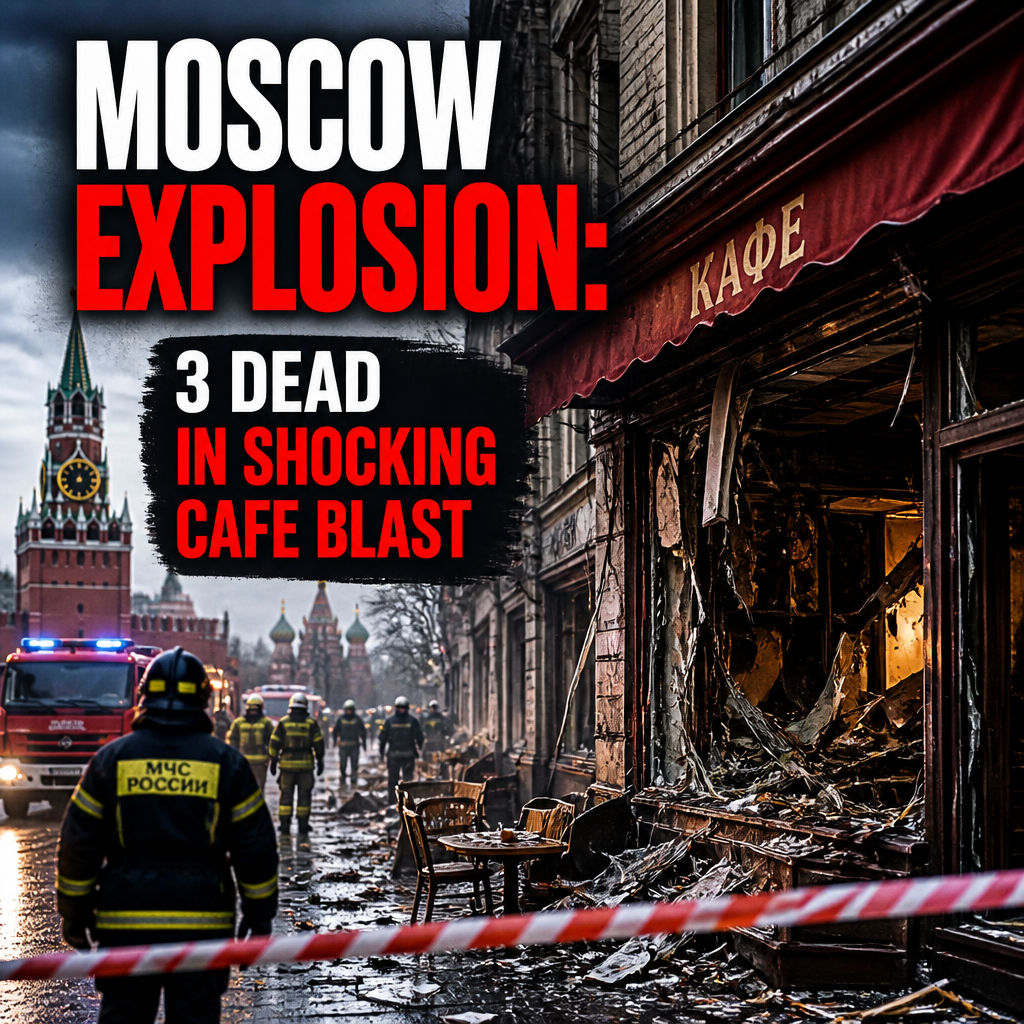
Moscow Explosion: 3 Dead in Shocking Cafe Blast


Moscow Explosion has put a fresh spotlight on the risks of public safety failures in Russia’s capital, after officials said a blast near a cafe killed three people and raised immediate questions about what caused the deadly incident.
The early reports were striking for both their speed and their uncertainty. Russian authorities moved quickly to confirm that the explosion happened near a cafe in Moscow and that three people died, but the broader picture remained unsettled. In fast-moving breaking-news situations like this, the first task is often separating confirmed facts from speculation, and that is especially important when the incident is being reported through outlets with very different editorial lenses.



What is clear is that a public place turned into a crime scene in an instant. What is not yet clear is whether the blast was the result of an accident, a gas-related failure, or something more deliberate. That uncertainty matters, because it changes not just the story’s meaning but also the political and security implications that follow.
Moscow Explosion: what is confirmed and what remains unclear
The confirmed details are stark: an explosion occurred near a cafe in Moscow, and three people were killed. The incident was serious enough to draw immediate official attention and widespread media coverage. Beyond that, the picture becomes less certain.




Different outlets tend to frame these events in different ways. Al Jazeera’s reporting, like much of its breaking-news coverage, places emphasis on verified official statements while avoiding premature conclusions. That approach is useful in a story still developing, because it keeps the focus on what can actually be substantiated rather than on theories racing ahead of evidence.
Russian state-aligned or Russia-based coverage often tends to emphasize order, response, and the official version of events. In that framing, the priority is typically the rapid work of investigators and emergency services, along with reassurance that the situation is being handled. That perspective can be helpful for understanding the state response, but it can also leave more room for unanswered questions about underlying causes.
International broadcasters such as Sky News usually approach incidents like this from a wider public-interest angle, focusing on the human toll, the disruption to city life, and the possibility that the blast could signal broader instability. That lens helps audiences outside Russia understand why the incident matters beyond the local neighborhood where it happened.
Taken together, the different approaches point to one essential conclusion: the facts are serious, but the final explanation is not yet settled.
Why the cause matters so much
At first glance, the distinction between accident and attack can seem technical. In reality, it shapes everything:
– If it was an accident, the focus shifts to building safety, inspection failures, and emergency preparedness.
– If it was criminal, the emphasis moves to motive, suspects, and security.
– If the cause is still unknown, the responsible position is caution, not conjecture.
This is why early reporting should be treated carefully. In a city like Moscow, even a localized blast can trigger a much broader conversation about public safety, infrastructure, and state competence. If the incident turns out to have been preventable, questions will likely turn to regulation and oversight. If foul play is confirmed, attention will move to how such an event could happen in a heavily monitored urban center.
Moscow Explosion and the challenge of reporting in real time
Breaking news in Russia is often difficult to verify quickly. Information can be fragmented, official statements may be limited, and independent confirmation can take time. That does not mean the initial reports are unreliable, but it does mean that readers should expect updates to change the story as investigators learn more.
A fair reading of the available coverage suggests three broad points of agreement:
1. A deadly explosion occurred near a cafe in Moscow.
2. Three people died, making this a significant and tragic event.
3. The cause was not immediately clear, and investigations were underway.
The disagreement lies mostly in emphasis. Some reporting leans toward the official account and the mechanics of the response. Other coverage asks what the blast reveals about safety and security in the city. Neither approach is wrong, but each highlights a different part of the story.
That balance is important because public reactions to incidents like this are often shaped by the first narrative that takes hold. In a politically charged environment, early assumptions can harden quickly. Responsible journalism has to resist that temptation and wait for evidence.
The human impact should stay central
It is easy, especially in international reporting, for casualty counts and official statements to dominate the conversation. But behind the headline is a scene of real loss: people caught in a sudden, violent event in an ordinary public space. Cafes are places associated with routine and social life, which makes the shock feel sharper.
That human dimension should not be overshadowed by speculation about motive. Three deaths are three too many, regardless of whether the cause was mechanical, accidental, or intentional. The most useful questions now are practical ones: Were emergency services able to respond quickly? Was the site properly secured afterward? Are investigators being transparent enough to build public confidence?
The answers will shape not only how this incident is remembered, but whether people feel safer in the city once the initial shock fades.
A cautious conclusion
For now, the most honest assessment is that the Moscow blast is both tragic and unresolved. The death toll alone makes it a major incident, but the lack of a confirmed cause means it should be treated with restraint rather than certainty. Russian officials, international broadcasters, and regional outlets may differ in tone, but they converge on the core reality that a deadly explosion has shaken Moscow and left important questions unanswered.
Until investigators provide a clearer account, the best reading is a cautious one: this was a serious event with immediate human consequences, but not yet a fully explained one. In a news cycle that often rewards speed over accuracy, that distinction is worth holding onto.

























